
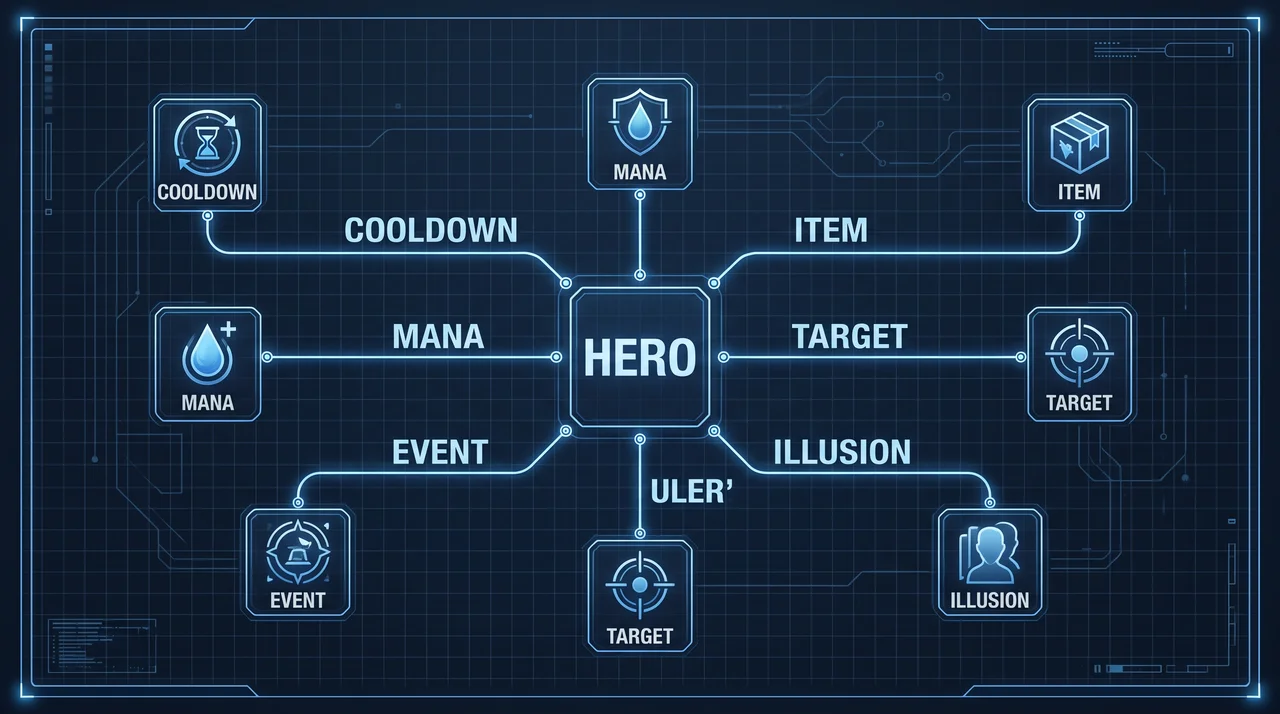
Heroes, items, cooldowns, illusions, and game events turn a simple macro idea into a state-management problem.
Quick answer: it is not one macro
Reliable Dota 2 automation is not “press one key, run one combo.” Even a simple-looking action may depend on mana, cooldowns, cast state, target validity, visibility, items, modifiers, allies, disables, and timing. Add more than one controllable unit and the state space gets messy fast. The right high-level model is an event-driven system that validates current state before choosing an action and showing the result. That model explains why hero coverage, observability, updates, and testing matter more than a giant marketing number for “supported scripts.” It does not require implementation or matchmaking automation instructions.
Events versus constant checking
Valve’s public Dota 2 Workshop Tools API offers a safe analogy. Custom-game scripts can register listeners and react when named events occur. A listener might hear that a phase changed, then let game-mode logic decide what to do next. Workshop scripting is a developer feature for custom experiences; it is not a cheat implementation.
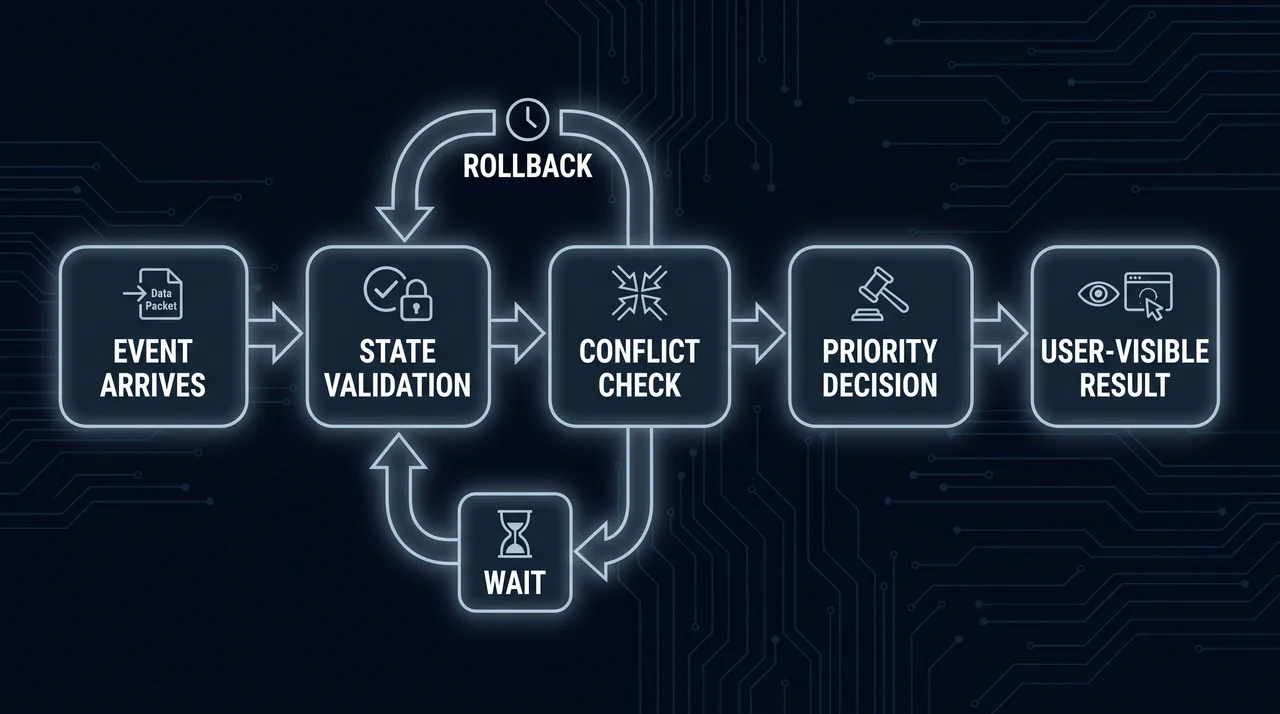
The architectural lesson still transfers. An event says something happened. It does not say the requested response is valid. A robust conceptual pipeline is:
receive an event;
read the relevant state;
reject stale or conflicting conditions;
choose a priority;
expose a user-visible result.
Polling can also observe state, but it creates its own problems: repeated checks, stale snapshots, ordering, and needless work. Real systems commonly blend event reactions with state validation.
Hero state creates a combinatorial problem
Dota’s roster is not a set of interchangeable characters. Each hero brings abilities, talents, modifiers, cast behaviors, and edge cases. Items add another changing layer. Patches can alter names, values, interactions, or the order in which states matter.
This is why one generic action model rarely covers everything well. A maintainable design needs shared concepts—cooldown checks, target selection, UI feedback—plus hero-specific modules that declare their own dependencies. If a shared rule changes, it should not silently break every module. If one hero changes, the rest should remain testable.
The problem is less like recording a keyboard macro and more like maintaining a family of small state machines. Feature count says very little unless the publisher explains scope, supported heroes, and what “supported” actually means.
Illusions and multiple units multiply conflicts
Illusions, summons, and other controllable units add selection state, ownership, target priority, and command conflicts. Two individually valid actions may still be wrong together. A command intended for the main hero can collide with a unit command; an old target can become invalid; a new disable can change the priority before the system presents a result.
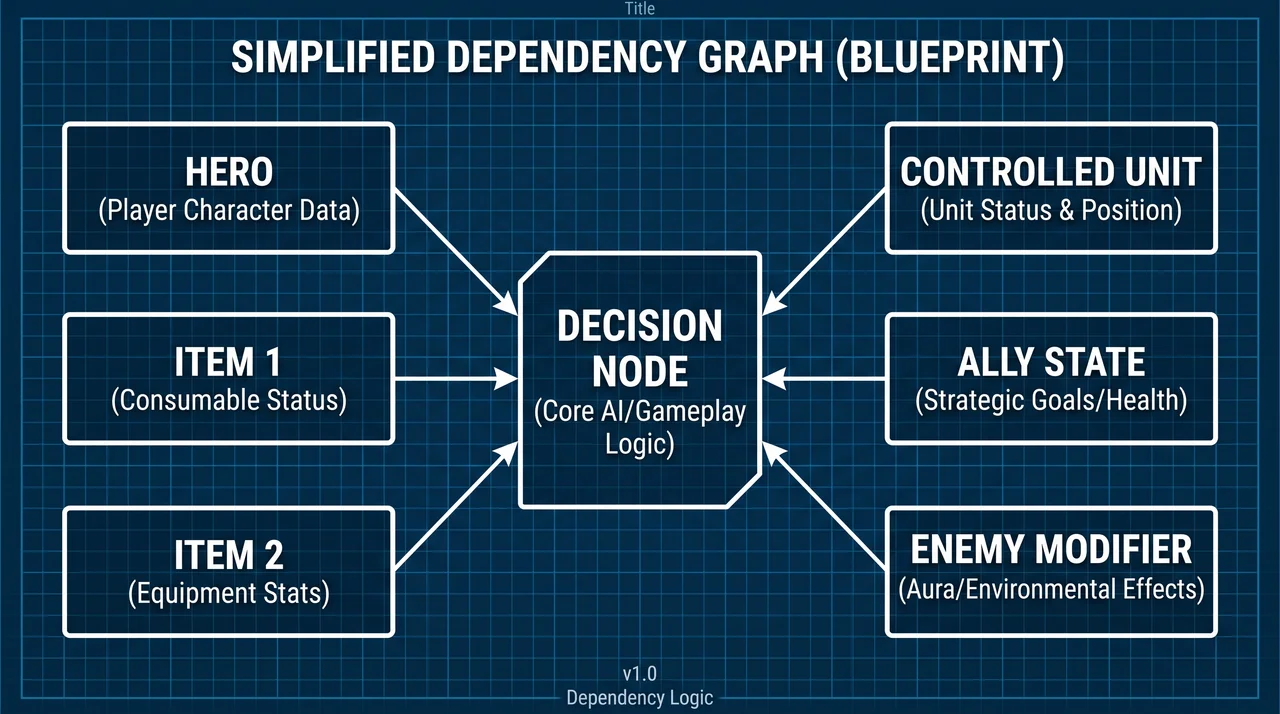
A useful conceptual dependency graph includes:
the currently selected unit;
the action owner;
target class and current validity;
hero and item availability;
active modifiers and disables;
a policy for conflicts and cancellation.
Maintainability is the real feature
Good architecture separates per-hero modules from shared utilities, versions configuration schemas, and keeps test cases for common and edge states. It also makes decisions observable: users should be able to see which module is active, which dependency is missing, and why a state was rejected.
When evaluating a product, ask:
Is feature scope documented per hero or only claimed globally?
Are dependencies and conflicts explained?
Can profiles be versioned, reset, and recovered?
Does the UI expose active state and errors?
Is there a dated update process and a real support path?
Once you understand the event and state-management burden, a feature list becomes easier to judge. This Dota 2 cheat comparison provides a market shortlist that can be evaluated by coverage, maintainability, and interface depth rather than raw feature count. Melonity is positioned around a broad script ecosystem, but breadth still needs documentation and ongoing maintenance.
To pressure-test a listing, pick one hero, one item interaction, one controlled unit, and one patch-sensitive modifier. Ask whether scope, conflicts, cancellation, and recovery are documented for that small slice. A product that explains a narrow slice clearly is easier to assess than one that claims the whole roster while hiding state and support details.
Repeat the check after a major game update. If the publisher cannot say which modules changed, the raw library size is not an actionable maintenance signal.
Conclusion
Dota 2 automation is difficult because the game keeps changing while many states interact at once. Events provide triggers; validation, conflict handling, modularity, tests, and clear UI make the system understandable. If a product page talks only about the number of scripts, it is skipping the engineering questions that actually matter.
Sources
FAQ
Why are Dota 2 hero scripts harder to maintain than macros?
They must account for changing hero, item, target, modifier, and multi-unit states rather than replaying one fixed input sequence.
What is event-driven scripting in a MOBA?
It is a design where named events trigger validation and decision logic. Valve’s Workshop API demonstrates the pattern safely in custom games.
Why do patches break automation logic?
Patches can change abilities, modifiers, items, identifiers, and interactions that a state model assumes.
Does a larger script library always mean a better product?
No. Dota 2 automation quality also depends on coverage definitions, updates, conflict handling, tests, UI clarity, and support.
About the author
- I talk about game hacking and game cheats. I have been developing game protection—as well as cheats—for over 10 years.
Comments
Join the discussionNo comments yet. Be the first to comment.
Dota 2 Cheats
All about Dota 2 cheats & hacks. Here you know everything about them and become professional.